Friday, November 24, 2023

paper no 101- Elizabethan and Restoration Literature- Assignment

 Assignment- Paper No: 101 

This Blog is Written as part of  Study Assignments Given To Sem- 1 Students of Department Of English, MKBU

 Name: Asha Rathod

Paper 101: Elizabethan and Restoration Literature

Subject Code: 22392

Topic Name: John Donne’s Poem ‘The Flea’

Batch: M.A. Sem-1 (2023-25)

Roll No: 3

Enrollment No: 5108230038

Email Address: asharathod1451@gmail.com

Submitted to: Smt. S. B. Gardi, Department of English, MKBU


'The Flea' Poem By John Donne


  • Introduction


John Donne was born in 1572 in London, England. He is one of the earliest of the ‘Metaphysical Poets’, a term created by Samuel Johnson, an eighteenth-century English essayist, poet, and philosopher to describe the loosely associated group of poets such as George Herbert, Richard Crashaw, Andrew Marvell, and John Cleveland. The Metaphysical Poets are known for their ability to startle the reader and view new perspectives through paradoxical images, subtle argument, inventive syntax, and imagery from art, philosophy, and religion using an extended metaphor known as a conceit. Donne reached beyond the rational and hierarchical structures of the seventeenth century with his exacting and ingenious conceits, advancing the exploratory spirit of his time.


The  Metaphysicals


Basically metaphysics is the branch of psychology. Literally metaphysics means beyond nature. In English literature, a number of writers used the concept of metaphysics to great effect and lasting long. Many writers have used the term metaphysics and have applied it in their corresponding literary works, but famously it was Samuel Johnson who very first time named the metaphysical poetry.


We can consider Metaphysical poetry as poetry marked by bold, Ingenious Conceits, Incongruous Imagery, Complexity and Subtlety of thought, frequent use of paradox and often by deliberate harshness or rigidity of expressions. Metaphysical poets have a common theme. They all had a religious sentiment. 
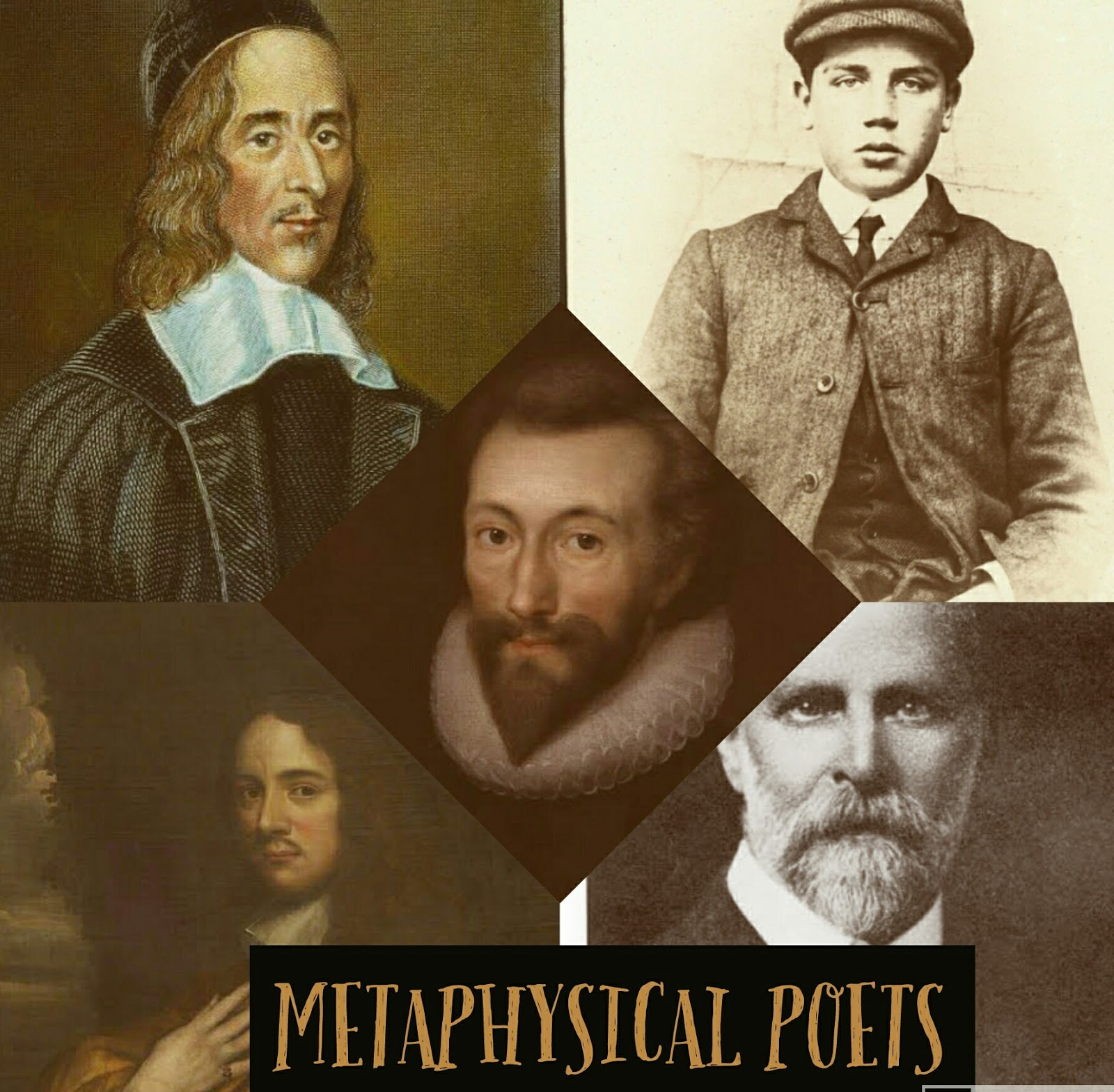


Poets, commonly grouped in a class which includes Donne, Herbert, Cowley, Crashaw, and others famous in their day, received the name of metaphysical poets, not because of their profound thought, but because of their eccentric style and queer figures of speech. 


 The name 'metaphysical poetry' was first devised by Dryden, in his Essay of Dramatic Poesy. It was revived by Johnson, and is now generally accepted by historians of English literature. It is used by Johnson, as it was used by Dryden, to express the love of remote analogies, which was a mark of the poetry of Donne and those who wrote more or less after the manner of Donne.


The metaphysical poets were men of learning, and to show their learning was their whole endeavour; but, unluckily resolving to show it in rhyme, instead of writing poetry, they only wrote verses, and very often such verses as stood the trial of the finger better than of the ear; for the modulation was so imperfect, that they were only found to be verses by counting the syllables. 


John Donne
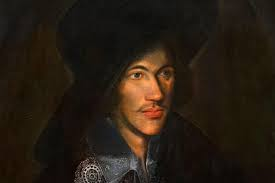


John Donne was born sometime in the first half of 1572 in the City of London. His father was a prosperous merchant of Welsh ancestry.Donne’s mother was Elizabeth Heywood The family had a strong Roman Catholic tradition.


In 1584, Donne matriculated at Hart Hall, Oxford. As it was impossible for a Roman Catholic to take the oath of supremacy required at graduation, he left without taking a degree. According to Izaac Walton, Donne went to Cambridge on leaving Oxford. He became a law student at Lincoln’s Inn in 1592. He read voraciously and lived gaily. He was described as a great visitor of ladies, a great frequenter of plays, and a great writer of conceited verses. Most probably he travelled extensively during the period between leaving Oxford and entering the rims of Court.


In 1601, he fell passionately and seriously in love with Ann More, the young niece of the Lord Keeper and, by his secret marriage to her, ruined his chances of a promising diplomatic career.His marriage proved to be the great error of his life from the worldly point of view. In his mood of despair, he wrote wittily to his wife: “John Donne, Ann Donne, Un-done.” (Porto)


From 1602 to 1615 Donne struggled to find ways to support himself and his growing family. His wife bore him twelve children, seven of whom survived her. She died a premature death in 1617. From 1602 to 1615 Donne struggled to find ways to support himself and his growing family. His wife bore him twelve children, seven of whom survived her. She died a premature death in 1617. 


He was ordained on the 23rd January 1615 and at the age of forty-three began a new life as a priest. Shortly after his ordination Donne was, by royal command, made a Doctor of Divinity at Cambridge. In 1621, he became Dean of St. Paul’s. There was a proposal in 1630 to make him a bishop, but he was by then a very sick man. He died in London on the 31st March 1631, and was buried in St. Paul’s, where his monument still stands. 


John Donne as Metaphysical Poet


When we begin exploring John Donne’s verse, the description of him as a ‘metaphysical’ poet is inescapable.Donne and the other 16th- and 17th-century poets gathered under the ‘metaphysical’ banner – Carew, Vaughan and Marvell to name some of the most renowned – didn’t form a cohesive movement in their own time.Although it’s important not to lose sight of the differences between these writers, Donne does make use of many typical ‘metaphysical’ features used by others in the group. 


The chief characteristic of Donne’s metaphysical poetry 


1. It is complex and difficult. Most varied concepts are brought together.

2. It is intellectual in tone. There is an analysis of the most delicate shades of psychological experience.

3. There is a fusion of emotion and intellect, as there is intellectual analysis of emotions personally, experienced by the poet. 

4. It is full of concepts which are learned, intellectual and over elaborated. 

5. It is argumentative. There is Cubic evolution of thought as Donne advanced arguments, after arguments to prove his points. He is often like a lawyer choosing the fittest arguments for the case. 

6. Originality is archived by the use of a new vocabulary drawn from the world of trade and commerce, the art and the science. 

7. In order to arrest attention to tone a poem begins abruptly and colloquially, and unusual rhythms are used, unusual compound words are also used for the same purpose. 

8. It is often dramatic in form. The blossom is the form of a dialogue between the poet and his heart which is treated as a separate entity; it has been well said his poetry presents a drama of ideas. His lyrics are dramatic. A poem of Donne’s is a piece of drama.


 Flea (insect) and literary arts


The flea has been, indirectly, one of the protagonists in the history of man. As one of the two vectors of Yersinia pestis, the etiological agents of the Black Death, the flea (Xenopsylla Cheopis) has contributed, over the centuries, to the death of millions of people in many countries. Galileo Galilei was the first to observe the flea with a microscope (1624), but the credit of depicting it with a stunning drawing goes to the Britisher Robert Hooke in 1665.

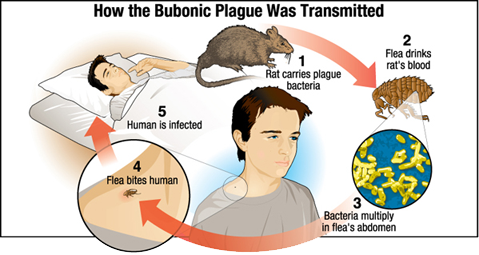

A number of zoologists, including Antonie Van Leeuwenhoek and Diacinto Cestoni, well described and illustrated the life cycle of the flea in the XVII century. Some of these reports inspired scholars such as J. Swift and J. Donne for the composition of classic poems. Also, the flea, alone and with its hosts, has inspired a number of artists to create fine paintings; among them: G. M. Crespi, G. B. Piazzetta, G. de la Tour and others. Colourful sonnets on the flea in the Roman dialect were written by G. Belli and Trilussa. The flea also, as a theme, inspired musicians such as G. F. Ghedini and M. Mussorgsky, play writers such as Feydeau and moviemakers such as Charlie Chaplin. 


The Flea

Fleas were a popular subject for ribald humour during the Renaissance. The creatures were everywhere in both real life and in erotic poetry (inspired by the writing of the Roman poet Ovid) – their ability to freely roam ladies’ flesh making them the envy of John Donne’s poetic narrator as well as many others. Since 17th-century society viewed sex as the mingling of bloods, the flea’s bloodsucking nature had huge possibilities as a risqué metaphor. 


It may come as a great surprise to people versed in some of John Donne’s

Better-known works that this great 17th century poet used as a Flea as a central figure in a love poem.“The Flea” is a steamy testimony of the passion for which the young poet was known as “the rake, Jack Donne”.


In “The Flea,” Donne builds a complex argument about a woman’s denial of love’s

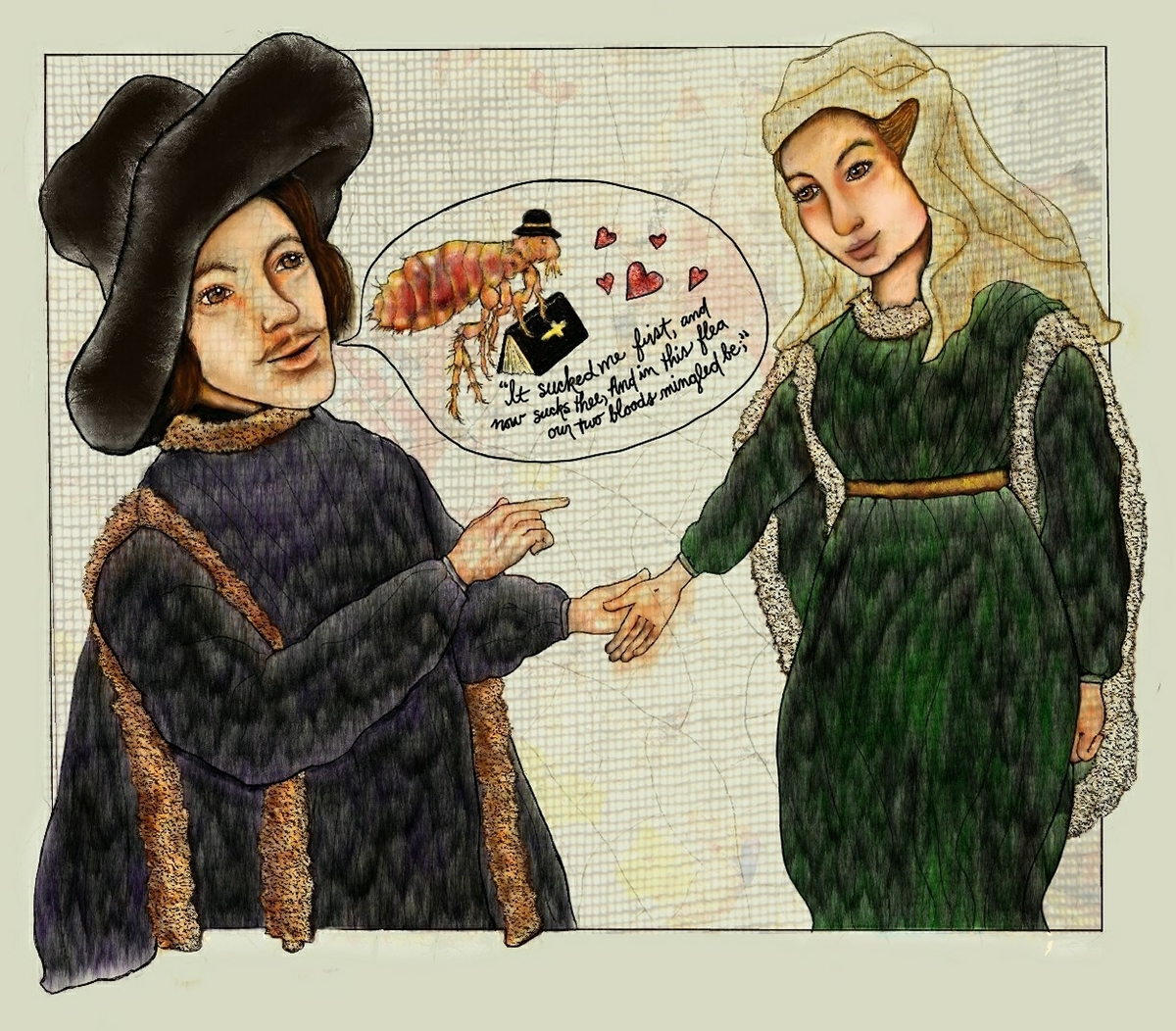
consummation with the poem’s persona. The poem is built around the simple situation where a flea has just bitten a man (the poem’s persona) and the woman that he loves. The woman is poised to crush the flea when the persona builds an elaborate argument that the insect and its act of feeding is a corporal, though symbolic, consummation of the love affair and possible marriage that she and her parents are denying in real life. The persona’s pleas fail to prevent her from crushing the flea with her fingernail. 


Poem’s Structure

Donne's poem is composed of three stanzas of nine lines. The first six lines in each stanza are made from three rhyming couplets, while the last three lines of each are a triplet. In this way Donne’s form mirrors his content as three distinctly separate entities – man, woman and flea – become one.


Poem Analysis 


Mark but this flea, and mark in this,   

How little that which thou deniest me is;   

It sucked me first, and now sucks thee,

And in this flea our two bloods mingled be;   

Thou know’st that this cannot be said

A sin, nor shame, nor loss of maidenhead,

Yet this enjoys before it woo,

And pampered swells with one blood made of two,

And this, alas, is more than we would do.


In the poem’s opening stanza, we are thus presented with a lusty lover seeking the ultimate favour from a young lady and he is meeting resistance; hence the necessity of the argument in the first stanza. The lover seeks to convince the young lady that the intimacy he seeks will in no way bring her shame or dishonor; for, after all (as Aristotle says), sexual intercourse is but the mingling of blood~13-which is exactly what happens when the flea bites first him, then her. Surely This is no loss of honour, merely the mingling of blood. But there is more here than a perverse argument. When the poem’s speaker reasons that the mingling of bloods that is his heart’s desire is like the mingling of bloods in a flea, he is, all unawarely, betraying that his love is as barren as the encyclopedists had described the flea’s to be. Like the flea, he will copulate, but produce no ‘creatures of like kind’. The speaker’s response to the flea’s mock pregnancy- the flea ‘swells with one blood made of two,and this is more then we would doe’-is further evidence that Donne is presenting us with a profane lover, a man whose love produces, in the language of the Roman de la Rose, a desire ‘More for delectation/Than only

procreation.’This lover’s is thus an inversion of a properly ordered love.


Oh stay, three lives in one flea spare,

Where we almost, nay more than married are.   

This flea is you and I, and this

Our marriage bed, and marriage temple is;   

Though parents grudge, and you, w'are met,   

And cloistered in these living walls of jet.

Though use make you apt to kill me,

Let not to that, self-murder added be,

And sacrilege, three sins in killing three.


Whereas in the first stanza he had attempted to demonstrate directly that a loss of honour is but an inconsequential thing, in the second stanza the argument is all by indirection. Seeing that the lady has captured and plans to execute the flea, he tries now to convince her that, since the flea has their two bloods, ‘This flea is you and I’. The lover spiritualizes his lady by first identifying her with a flea, and then spiritualizing the flea! The flea is a cloister, a ‘temple’. In fact, the flea is more than sacred. It is divine, a Trinity-‘three lives in one flea’. Like Christ’s, the flea’s blood is the royal, purple, ‘blood of innocence’, and the flea, again like Christ, is nailed, though not to a cross. Further, if the flea is a trinity, the lover and his mistress are members of that Godhood. But, neither the argument nor the double entendre speeds the lover, and he is forced to try again. At the opening of the third stanza the lady has squashed the flea.


Cruel and sudden, hast thou since

Purpled thy nail, in blood of innocence?   

Wherein could this flea guilty be,

Except in that drop which it sucked from thee?   

Yet thou triumph’st, and say'st that thou   

Find’st not thy self, nor me the weaker now;

’Tis true; then learn how false, fears be:

Just so much honor, when thou yield’st to me,

Will waste, as this flea’s death took life from thee.


The lady’s action is, of course, a rather nice refutation of the lover’s argument of the preceding stanza, for, whereas he had assured her that they both, along with God and their marriage bed were bundled up inside the flea, she has driven her nail into the purple ‘blood of

innocence’-and the earth does not groan, there is no darkness upon the face of the earth, the veil of the temple is not rent; indeed, she finds them neither one ‘the weaker now’. Obviously another strategy is required. So the lover tries an argument by analogy. He admits freely that the flea’s death was trivial, but from that fact she is to Learn how false her  fear was. Fear in anticipation of the flea’s death proved false; fear for the loss of honour, when she yields, will, he assures her, prove equally false, as this flea’s death took life from her, He’ll take just a little honour. She’ll be none the weaker. Patently, This is a perverse argument. The lover is confusing the quantitative with the qualitative. Of blood one can lose a little or a lot, with

effects varying accordingly; but honour is qualitative: she either has it, or she’s lost it. Thus the lover is a man who uses reason, perverse reason, for the wrong ends.


Conclusion 

In  "The Flea" Donne wrote of secular or physical love in a somewhat lighter vein than he usually did. By this statement I do not mean to imply that he was being humorous, though the use of a flea, a curious little insect given to leaps, frolics, and sudden little scurryings, may have carried humorous overtones to the Renaissance mind.

Dryden has attacked this poem on the grounds that it is not realistic, that no lady would yield to such an argument There are no wild protestations of undying love, no impassioned pleadings for the lady to be kind, no appeal to the emotions whatsoever. Instead, the appeal is to the reason. One has to agree with Dryden that such an " approach" would not prove efficacious unless—unless the lady were as desirous of being convinced as the lover of convincing. This conception of ladies is fairly common in Donne's secular poetry. 


Resources:

Amici, Roncalli R. “[The history of the flea in art and literature].” PubMed, June 2004, https://pubmed.ncbi.nlm.nih.gov/15305680/. Accessed 24 November 2023.

Bansal, Atal Bihari. “METAPHYSICS IN LITERATURE.” JETIR, vol. 7, no. 2, 2020. ISSN-2349-5162.

Brumble, H. David. “John Donne ’ s ‘The Flea’ : Some Implications of the Encyclopedic and Poetic Flea Traditions.” Critical Quarterly, vol. 15, no. 2, 1973.

Cohen, Allen C. “A Man, A Woman, and the Insect That Consummated Their Love: Passion and Metaphysical Conceit in John Donne’s “The Flea.”” American Entomologist, vol. 48, no. 2, 2002.

Donkor, Michael, et al. “John Donne and metaphysical poetry.” The British Library, 31 March 2017, https://www.bl.uk/shakespeare/articles/john-donne-and-metaphysical-poetry. Accessed 24 November 2023.

Long, William J. “Outlines of English and American Literature by William J. Long.” Project Gutenberg, 2005, https://www.gutenberg.org/ebooks/7800. Accessed 24 November 2023.

MADISON., ARTHUR L. “EXPLICATION OF JOHN DONNE'S "THE FLEA."” Notes And Queries, vol. 202, no. February, 1957.

Porto, Andrea J. “John Donne Biography.” Lit Aid, 2020, https://litaid.com/john-donne-biography/#Poetic_works_of_his_middle_years. Accessed 24 November 2023.

Raj, Prithvi. “A Study of John Donne as a Metaphysical Poet.” INTERNATIONAL JOURNAL OF CREATIVE RESEARCH THOUGHTS, vol. 8, no. 10, 2020. ISSN: 2320-2882.

Vaughan, Charles Edwyn. “English literary criticism by Charles Edwyn Vaughan.” Project Gutenberg, 2004, https://www.gutenberg.org/ebooks/6320. Accessed 24 November 2023.


Words= 2551,  images= 6, resources cited =10


Paper No: 102 Literature of the Neo-classical Period -Assignment

 Assignment- Paper No: 102

This Blog is Written as part of  Study Assignments Given To Sem- 1 Students of Department Of English, MKBU

Name: Asha Rathod

Paper 102: Literature of the Neo-classical Period

Subject Code: 22393

Topic Name: Johnathan Swift Life and Work

Batch: M.A. Sem-1 (2023-25)

Roll No: 3

Enrollment No: 5108230038

Email Address: asharathod1451@gmail.com

Submitted to: Smt. S. B. Gardi, Department of English, MKBu


JONATHAN SWIFT

“We have just enough religion to make us hate, but not enough to make us love one another.”

                                    -Jonathan Swift

 BORN: 30 November 1667, Dublin, Ireland

DIED: 19 October 1745, Dublin, Ireland

Background Information

Jonathan Swift was born on November 30, 1667 in Dublin, Ireland. His father died seven months before he was born leaving the Swift family in a difficult financial situation. At the age of four Swift’s mother sent him to live with his wealthy uncle, Godwin. Swift became a well educated man, studying at the Kilkenny Grammar School from 1674-1682. He then went on to study at Trinity College in Dublin from 1682-1689 where he received B.A. and M.A. degrees. In 1688, Swift moved to England and stayed with Sir William Temple at Moor Park where he was welcomed into the Temple household due to his mother’s relation to Lady Temple. During his stay at Moor Park, Swift taught a girl named Esther Johnson (Stella). This job turned out to be a landmark in Swift’s life. Swift returned to Ireland in 1699 after the Death of William Temple. Swift’s residence in Ireland did not stop him from making occasional trips to London, gaining fame from his essays. Stella eventually grew up and moved to Ireland in order to live closer to Swift. She also accompanied Swift on every one of his trips to London. Many believe that Stella and Swift were married in 1716. Unfortunately, Stella passed away in 1728 which had an impact on Swift for the rest of his life.

From 1707-1709 Swift was an Emissary in London for the Irish clergy. Swift attempted to begin a political career among Whigs in 1710. While this did not work out, Swift changed political parties(the Tories) and began to take over a journal called The Examiner. Soon, the Tories lost political power and this forced Swift to leave the news journal. After his political endeavors, Swift became the dean of St. Patrick’s Cathedral from 1713-1742. During this time, many believe that Swift began to suffer from a form of Alzheimer’s disease. Swift had also been struggling with deafness since he was 20. On October 19, 1745 Swift died in Ireland.

Swift wrote his own Epitaph and it said:
“Swift has sailed into his rest.
Savage indignation there
cannot lacerate his breast.
Imitate him if you dare,
world-besotted traveller.
He served human liberty.”

He  was an Anglo-Irish satirist, essayist, political pamphleteer (first for the Whigs, then for the Tories), poet and Anglican cleric who became Dean of St Patrick's Cathedral, Dublin,  hence his common sobriquet, "Dean Swift".

Swift is remembered for works such as A Tale of a Tub (1704), An Argument Against Abolishing Christianity (1712), Gulliver's Travels (1726), and A Modest Proposal (1729). He is regarded by the Encyclopædia Britannica as the foremost prose satirist in the English language, and is less well known for his poetry. He originally published all of his works under pseudonyms—such as Lemuel Gulliver, Isaac Bickerstaff, M. B. Drapier—or anonymously. He was a master of two styles of satire, the Horatian and Juvenalian styles.

His deadpan, ironic writing style, particularly in A Modest Proposal, has led to such satire being subsequently termed "Swiftian".

Early life:

Jonathan Swift was born in Dublin, Ireland, on November 30, 1667. The son of an English lawyer, he grew up there in the care of his uncle before attending Trinity College at the age of fourteen, where he stayed for seven years, graduating in 1688. In that year, he became the secretary for Sir William Temple, an English politician and member of the Whig party. In 1694, he took religious orders in the Church of Ireland and then spent a year as a country parson. He then spent further time in the service of Temple before returning to Ireland to become the chaplain of the Earl of Berkeley. Meanwhile, he had begun to write satires on the political and religious corruption surrounding him, working on A Tale of a Tub, which supports the position of the Anglican Church against its critics on the left and the right, and The Battle of the Books, which argues for the supremacy of the classics against modern thought and literature. He also wrote a number of political pamphlets in favor of the Whig party. In 1709 he went to London to campaign for the Irish church but was unsuccessful. After some conflicts with the Whig party, mostly because of Swift’s strong allegiance to the church, he became a member of the more conservative Tory party in 1710.


Unfortunately for Swift, the Tory government fell out of power in 1714 and Swift, despite his fame for his writings, fell out of favor. Swift, who had been hoping to be assigned a position in the Church of England, instead returned to Dublin. During his brief time in England, Swift had become friends with writers such as Alexander Pope, and during a meeting of their literary club, the Martinis Scribblers Club, they decided to write satires of modern learning. The “third voyage” described in his best-known work, Gulliver’s Travels, is assembled from the work Swift did during this time. However, the final work was not completed until 1726, and the narrative of the third voyage was actually the last one completed. After his return to Ireland, Swift became a staunch supporter of the Irish against English attempts to weaken their economy and political power, writing pamphlets such as the satirical A Modest Proposal, in which he suggests that the Irish problems of famine and overpopulation could be easily solved by having the babies of poor Irish subjects sold as delicacies to feed the rich.

Swift's Ireland was a country that had been effectively controlled by England for nearly 500 years. The Stuarts had established a Protestant governing aristocracy amidst the country's relatively poor Catholic population. Denied union with England in 1707 (when Scotland was granted it), Ireland continued to suffer under English trade restrictions and found the authority of its own Parliament in Dublin severely limited. Swift, though born a member of Ireland's colonial ruling class, came to be known as one of the greatest of Irish patriots. He, however, considered himself more English than Irish, and his loyalty to Ireland was often ambivalent in spite of his staunch support for certain Irish causes. The complicated nature of his own relationship with England may have left him particularly sympathetic to the injustices and exploitation Ireland suffered at the hands of its more powerful neighbor.


Although Swift's disgust with the state of the nation continued to increase, A Modest Proposal was the last of his essays about Ireland. Swift wrote mostly poetry in the later years of his life, and he died in 1745.


Vision is the art of seeing things invisible.”

                                                -Jonathan Swift

A MODERN PROPOSAL AND OTHER SATIRE

Early Years and Education

Jonathan Swift was born into a poor family that included his mother (Abigail) and his sister (Jane). His father, a noted clergyman in England, had died seven months before Jonathan's birth. There is not much known of Swift's childhood, and what is reported is not always agreed upon by biographers. What is accepted, however, is that Jonathan's mother, after the death of her husband, left the children to be raised by relatives (probably uncles), while she returned to her family in England (Leicester). It is also reported that Swift, as a baby, was taken by a nurse to England where he remained for three years before being returned to his family. This is open to conjecture, but the story contributes to the lack of information available regarding Swift's childhood.

Beginning in 1673, Swift attended Kilkenny Grammar School, where he enjoyed reading and literature and excelled especially in language study. In 1682, Swift entered Trinity College where he received a B.A. by "special grace," a designation for students who did not perform very well while there. Upon leaving Trinity College, Swift went to England to work as a secretary (a patronage position) for Sir William Temple. In 1692, Swift received an M.A. from Oxford; in 1702, he received a D.D. (Doctor of Divinity) from Dublin University.

Swift's Career

From approximately 1689 to 1694, Swift was employed as a secretary to Sir William Temple in Moor Park, Surrey, England. In 1694, he was ordained as a priest in the Church of Ireland (Anglican Church) and assigned as Vicar (parish priest) of Kilroot, a church near Belfast (in Northern Ireland). In 1696, he returned to working with Sir William Temple, and in 1699, after the death of Sir William, he became chaplain to Lord Berkley.


In 1700, Swift became the Vicar of Laracor, Ireland, and he was also appointed pretend (an honorary clergyman serving in a cathedral) at St. Patrick's Cathedral in Dublin. In 1707, Swift was appointed as an emissary to the Church of Ireland, and in 1713, he was appointed as Dean of St. Patrick's Cathedral in Dublin. Throughout all this time, and, indeed, after his appointment as Dean of St. Patrick's, Swift continued writing satirically in various genres, including both prose and poetry, using various forms to address different causes, including personal, behavioral, philosophical, political, religious, civic, and others.

Swift's Major Literary Works

The Test Act, a law enacted by Charles II, requiring office holders to declare their allegiance to the king over the church. The Journal to Stella (1710-1713), a series of letters written by Swift to Esther Johnson and Rebecca Dingle, includes the poem "The Windsor Prophecy," a satirical attack on the person and personality of the Duchess of Somerset, Queen Anne's red-haired attendant who did not care for Swift because of disparaging remarks Swift had written about her family.


Swift is also recognized as a defender of Ireland. In A Modest Proposal (1729)a reaction to English commercial practices that negatively impacted Ireland, Swift wrote one of the greatest works of sustained irony in English or any other language. Instead of maintaining that English laws prevent the Irish from manufacturing anything to sell, he argues that the only items of commerce that the English don't restrict are Irish babies and reasons that the Irish would be better off as cattle to be butchered than as a colony to be starved by the English. The Drapier's Letters (1724) is Swift's response to the continued subjugation of all aspects of the lives of those living in Ireland by England. The Letters aroused so much opposition that the English offered a reward of £300 for the name of the author. Although the Irish knew that he had written the letters, they did not betray him. They made him a national hero instead.

In his most recognized novel, Gulliver's Travels (1726), Swift presents a satire on all aspects of humanity by pointing out the weaknesses, vices, and follies inherent in all human beings; the satire reaches its apex in Swift's comparison of Houyhnhnms (horses) and Yahoos (human-like creatures) in Book IV.

Swift’s Writing

Contemporary Reactions to A Modest Proposal
A Description of the Morning
A Description of a City Shower

 Resources:

Fox, Christopher. “THE CAMBRIDGE COMPANION TO JONATHAN SWIFT.” Assets - Cambridge University Press, https://assets.cambridge.org/97805218/02475/frontmatter/9780521802475_frontmatter.pdf. Accessed 23 November 2023.

Quintana, Ricardo and Luebering, J.E.. "Jonathan Swift". Encyclopedia Britannica, 15 Oct. 2023, https://www.britannica.com/biography/Jonathan-Swift. Accessed 23 November 2023.

Swift, Jonathan. “Jonathan Swift Biography, Works, and Quotes.” SparkNotes, https://www.sparknotes.com/author/jonathan-swift/. Accessed 23 November 2023.


Words -1983, image-2


Sunday, November 19, 2023

Youth festival - 2023

youth festival-2023

 Maharaja Krishnakumarsinhji Bhavnagar University 

Hello friends,my self Asha Rathod I'm student of mkbu University of Bhavnagar in Department of English...we had organised  31St youth festival (યુવક મહોત્સવ -2023) on topic "નારી શક્તિ વંદના" on date  3 November to 5 Nomber,2023 continue three days start at 7 am to late night still 10 pm... 

As part of youth festival University held kalayatra at shamladas arts College on 2 November 2023 . I had not participated any activities but i became volunteer only for kalayatra...I have to caught the banner about સ્ત્રી- શિક્ષા .we have doing greatful performance in kalayatra...you can watch in this video

We can't performed there like this because of we have to walk on road ... kalayatra started at shamladas arts College to j.k Sarvaiya college at sardarnagar... our registration number is 9 (Department of English). there were so many students from different colleges in kalayatra with different costume coming with unique idea like " મોબાઇલ ની માયાજાળમાં માનવી..., નરેન્દ્ર મોદી થીમ, ભારતમાતા, ચંદ્રયાન સફળ, ટેકનોલોજી, નારી તું નારાયણી, સમાજ ના બંધન માં માનવી...etc..this are some photos about kalayatra I was become volunteer for kalayatra...you can see in this photo what I had to worked...


Let's talking about yuva mahotsav -2023 this is theme song by Himal Pandya while he was travelling....youtube channel

Reason of organised of youth festival: Students can showcase their hidden talents through these activities, finding relaxation and mental relief amidst the pressures of their studies.


This is timetable of youth festival five different center at atal auditorium, new court hall, English department, external department and  Amphitheater...I joined to visit all  three days in youth festival and I enjoyed a lot...

In first day there were some events like mimicry, skrit, ભજન, એકાંકી, કોલાજ, સ્વરચિત કાવ્ય પઠન, તત્કાલ ચિત્ર, લોકનુત્ય , પ્રશ્નમંચ ...all events were different place in University...
This is the picture of stadium of amphitheatre where held a opening ceremony..every events goes live strime those students who were not present there they can watch through this videos you can watch live video of opening ceremony 


every events goes live strime those students who were not present there they can watch through this videos you can watch live video of opening ceremony click here...first "To enlighten the lamp."by yuvraj and dilipsinh Gohil and they advised us to why to choose this theme Nari shakti Vandana....there are some guests presented in opening ceremony Bhartiben shiyal, J.K Sarvaiya college head bharatsingh gohil, shamladas arts colleges's  head j.b gohil and sir p p institute head of m.m Trivedi and jayveer Raj Gohil also there and they told everyone that " જે મર્દ નારીનો સન્માન ના કરી શકે તે ના મર્દ કહેવાય" ..., પરાક્રમ ભલેહી માતૃત્વ કે પાસ રહા , માતૃત્વ સિર્ફ સ્ત્રી કર સકતી હૈ...in opening ceremony sagardan ghadhvi also there who sang a song we enjoyed a lot...

mimicry click here
skrit  click here
ભજન CLICK HERE
હળવું કંઠ્ય સંગીત CLICK HERE
લોકનૃત્ય CLICK HERE
એકાંકી  CLICK HERE
eloctution CLICK HERE

શાસ્ત્રીય વદન તાલ વાઘ  CLICK HERE
શાસ્ત્રીય નૃત્ય  CLICK HERE
લોકગીત CLICK HERE
શાસ્ત્રીય વદન સ્વર વાઘ CLICK HERE
એકપાત્રિય અભિનય CLICK HERE
લોક વાઘ વૃંદ દુહા છંદ  CLICK HERE
સમૂહ ગીત  CLICK HERE
માઈમ  CLICK HERE
પૂર્ણાહુતિ સમારોહ  CLICK HERE

first day 

At 8:30 am starting registation ,our collage code was 51(Department of English) and ઉદ્દઘાટન સમારોહ at Amphitheater then in afternoon first start mimicry


mimicry: 

Mimicry is the resemblance of one organism to another or to its surroundings, providing a survival advantage. It can be protective (defensive) or aggressive (offensive) in nature, helping an organism either avoid predators or deceive prey.

there are some guest presents who is master in mimicry one of them solanki vijay (national player in mimicry) and niren bhatt ( writer, tv  serious like "તારક મહેતા ઉલ્ટા ચશ્મા" he worked on it for 2 year..works like બારા, પેરિયા, વેન્ટિલેટર, wrong side, રાજુ, all is well, and specially upon women works is bhediya, skyford and webseries name is અસુર.....this activity started at 2:00 pm o clock


There were some students participating in mimicry All were doing well performance that like original animal doing....most of participating boys no one girl was participating in this activity..they are copying voice like cock, crying child, conch, dog , selling men, diffrent vehicles voice like bike, bullet...., peacock, ghost door, cat, wall watch, mosquito, table tennis, heart beat, duck, fighting of dog, gun, rocket, fox, donkey, bus station suggetion voice, helicopter, d.j ,  and cartooning  character voice..in this activity we can perform only five minute...

Skit:

A "skit" is a short, humorous performance, often a brief comedic sketch or play. Skits are commonly used in theatrical settings, variety shows, or informal gatherings to entertain and amuse the audience. They usually focus on lighthearted or satirical content, aiming to provoke laughter through exaggerated characters or amusing situations.


They were performed on topic 1) BMC satire on about road...song like ( શેરમાં રે શેરમાં રે... ચાલી BMC ની ગાડી ટોપ ગેરમાં રે...) , ( ખાડા પુરો ભાઈ) , they want to give big message that we had cut tex rupees by government but not did anything for society..in Bhavnagar we can see this type of road at કુંભારવાડા and ધોબીઘાટ...then 2 ) દાદાની વાતો: we can see in contemporary time that many changes dk they can want to show about different between old time and this time....we can imagination only... song like ( પાવલી લઈને હું તો પાવાગઢ ગઇ હતી) we can see in this song that we can't go anywhere in little money how changes in this century....then 3) difference after marriage and before marriage:in this skit they want to show many changes in character so between fighting with parrents...in one dialogue that say by women ( પહેલા કોયલ જેવો અવાજ કહેતા અને હવે કા કા કરતો કાગડા જેવો લાગે છે..) then 4) politics: we can see  two diffrent bhajap and Congress they satire on Pakistan is bagger country.. they give promise that they can give lots of quality like build bridge they sung song ( મુઝે ચિતા બનાકે ભેજે તુંઝે ગાય બનાકે ભેજે) we can find through this song that if he will become cow..so leopard can eat it....( ભાવનગર છે કે diverson નગર)  5) નવા ભારતનો ચેહરો: in this skit yamraj want to take someone's death and complated his Target but when someone is going to die there are some situation alive that if someone going to die because of accident there are 108 ambulance 🚑,if anyone got lost in farm for farmers pm Plan ..if any one is pain for બેરોજગારી, if someone die by decease of the dirt ..( સ્વચ્છ ભારત, કોરોના વેક્સિન) only Indian army can watch yamraj...6) સન્નાટા..so these are some topic releted skit that I have watched so many messages given by skit

ભજન: 


A bhajan is a devotional song, often expressing love and reverence for a deity in various religious traditions, including Hinduism. Bhajans are typically sung in a melodic and repetitive manner to invoke spiritual emotions.

તત્કાલ ચિત્ર:


પ્રશ્નમંચ:
In there don't allowed to watch because of this activity gone in Department of English in room..it was so small and if someone speaking answer coincidence so whole game was gone wrong so very hard to watch it....

"લોક નૃત્ય" 

So, "falkdance" seems to be a misspelling. It refers to traditional dances performed by people in a particular region or community. These dances often reflect the culture, customs, and traditions of the people. It's a beautiful way to celebrate and express their heritage through movement and music. 

એકાંકી:

A one-act play is a theatrical piece that consists of a single act, typically with no intermission. It's a concise form of storytelling often used for shorter performances or festivals.

સુગમગીત:

"Sugam" typically refers to a genre of Nepali music known for its melodious and soothing tunes. It is often associated with easy-listening and enjoyable songs. 

કોલાજ:

A collage is a creative composition made by combining various materials such as photographs, paper, fabric, or other objects to create a visually appealing artwork.

સ્વરચિત કાવ્યપઠન:

Poetry recitation refers to the act of verbally presenting a poem before an audience. It involves reading or performing the poem aloud with attention to rhythm, tone, and expression to convey the emotions and meaning of the written words.


Second day


સમૂહ ગીત:


A group song typically refers to a musical performance where multiple individuals sing together, creating a harmonious or coordinated sound. It can involve various vocal parts and is often a collaborative effort among singers. Group songs are common in various genres, including choir music, a cappella, and popular music with vocal groups or bands.

વક્તૃત્વ સ્પર્ધા:


Elocution is the art of effective public speaking, emphasizing clear pronunciation, distinct speech, and appropriate expression to communicate ideas persuasively.

We have got only five minute for express our thoughts what they had give us..there are present judges name is vinod vyas, Ashish kharod and Jayesh dave who was played drummer in 1990  when he was student he published સામયિક આસપાસ, ચિત્રલેખ..there are some topic that we have to speak any one topic...

1) યત્ર નારિયેત્સુ પૂજ્યતે
2) ચાલો વૃદ્ધાશ્રમ ઘટાડિયે
3) બુલંદ ભારત કી બુલંદ તસ્વીર
4) આતંકવાદ
5) પાયાર્વરણ અને મનુષ્ય એક સિક્કા ની બે બાજુ
6)Ai benifit vs lost 

These were the subjects for the elocution competition, and Trushali from our department participated in it.

Clay Modaling :


Artists typically start with a lump of clay and use their hands or tools to shape and mold it into the desired form. Clay modeling allows for a high level of detail and expression, making it a versatile and widely used technique in the world of sculpture and art.


Poster Making : 


Poster making is the creation of visual displays, combining text and images to convey a message, promote an event, or communicate information. It involves graphic design skills and focuses on producing eye-catching displays for various purposes, such as advertising, promotion, or raising awareness.

  • Save Water
  • Education for Girls
  • Service to the Elderly 

Essay: 


An essay is a written composition that presents and explores a particular topic or issue. It typically involves the author's perspective, arguments, and insights on the subject matter, and is structured with an introduction, body paragraphs, and a conclusion. Essays can serve various purposes, including conveying information, expressing opinions, analyzing a topic, or persuading the reader. They are commonly used in academic settings, journalism, and other forms of written communication.

1. ભારતની અવકાશી હરણફળ - Benefits of India's Agricultural Opportunities
2. કિચનથી કેબિનેટ - નારી તુ ના હરણી - From Kitchen to Cabinet - Woman, You Are Not Weak
3. યુદ્ધો અનિવાર ખરા - War: A Solution Always
4. મૂળનિષ્ઠ શિક્ષણની આગત્યતા- The Necessity of Fundamental Education
5. પ્લાસ્ટિક પ્રદૂષણ: સમસ્યા અને ઉપાયો  - Plastic Pollution: Issues and Solutions

These were the subjects for the essay, and Insiya from our department participated in it.

Cartooning : 


Cartooning refers to the art and technique of creating cartoons, which are humorous or satirical illustrations often accompanied by captions or speech balloons. Cartoons can take various forms, including single-panel cartoons, comic strips, and animated cartoons. Cartoonists use visual elements, such as exaggerated characters, caricatures, and simple yet expressive drawings, to convey messages, tell stories, or provide commentary on social, political, or cultural issues. Cartooning is a form of visual storytelling that combines artistic skills with a sense of humor or wit to engage and entertain audiences.


1.મોંઘવારી
2. ચૂંટણી 
3. ગાંધીજી અને જનતા

These were the subjects for the Cartooning competition, and Dhatri from our department participated in it.

Rangoli : 


Rangoli is a traditional Indian art form in which intricate patterns and designs are created on the ground or floor, typically in courtyards or public spaces, using colored powders, rice flour, flower petals, or other decorative materials. These designs are often made during festivals, celebrations, and special occasions, serving as a form of decoration and symbolizing good luck and prosperity. Rangoli patterns can vary widely, incorporating geometric shapes, floral motifs, and cultural symbols. The practice of creating rangoli is common in various regions of India and is considered a creative and festive expression of art and culture.


Trushali from our department participated in it.

she got secound rank in this event .


Mono Acting : 


Monoacting, or monologue acting, refers to a performance where a single actor delivers a speech or a presentation alone on stage, portraying one or more characters or expressing a narrative. In monoacting, there is typically no interaction with other performers, as the focus is on the solo performer's ability to convey emotions, tell a story, or present a message through their acting skills and delivery.

This form of acting allows the performer to showcase their talent in a one-person show, often requiring versatility to portray different characters, moods, or situations within the same performance. Monoacting is commonly used in theater, drama competitions, and various performance arts settings as a way for actors to demonstrate their individual acting prowess.

 Indian Group Song : 


For the Indian group song, a combination of two songs was performed. The first segment featured patriotic songs, and the list included:

1. "Ye Vakt Ki Pukar Hai"
2. "Pranthi Pyaro Bharat Desh Vishal"
3. "Sare Jaha Se Achcha"
4. "Yun Samay Ki Ret Pe Chode Chalo Nishan"

Following the patriotic songs, the performance transitioned to folk songs:

1. "Veran Vahani Vagi"
2. "Koi Ke Odhav Ave, Koi K Madav Ave"
3. "Zulan Morli Vagi"
4. "Othal Padmni"


Thank You 


Paper 206: The African Literature- Presentation

 Paper 206:  The African Literature-  Presentation  Youtube Video :-